The jigsaw puzzle you’ll actually finish: a grown-up’s buying guide
Piece counts, glare, wobbly fits and the one kind of picture that will sit half-done on your table until Easter. How to choose a puzzle that ends with the last piece in.
In this story
What piece counts mean
Large-piece puzzles
Fit and cut
Matte vs. glare
Brutal images
Brands worth knowing
Sorting and lighting
Mats and boards
Puzzles and the brain
Questions readers ask
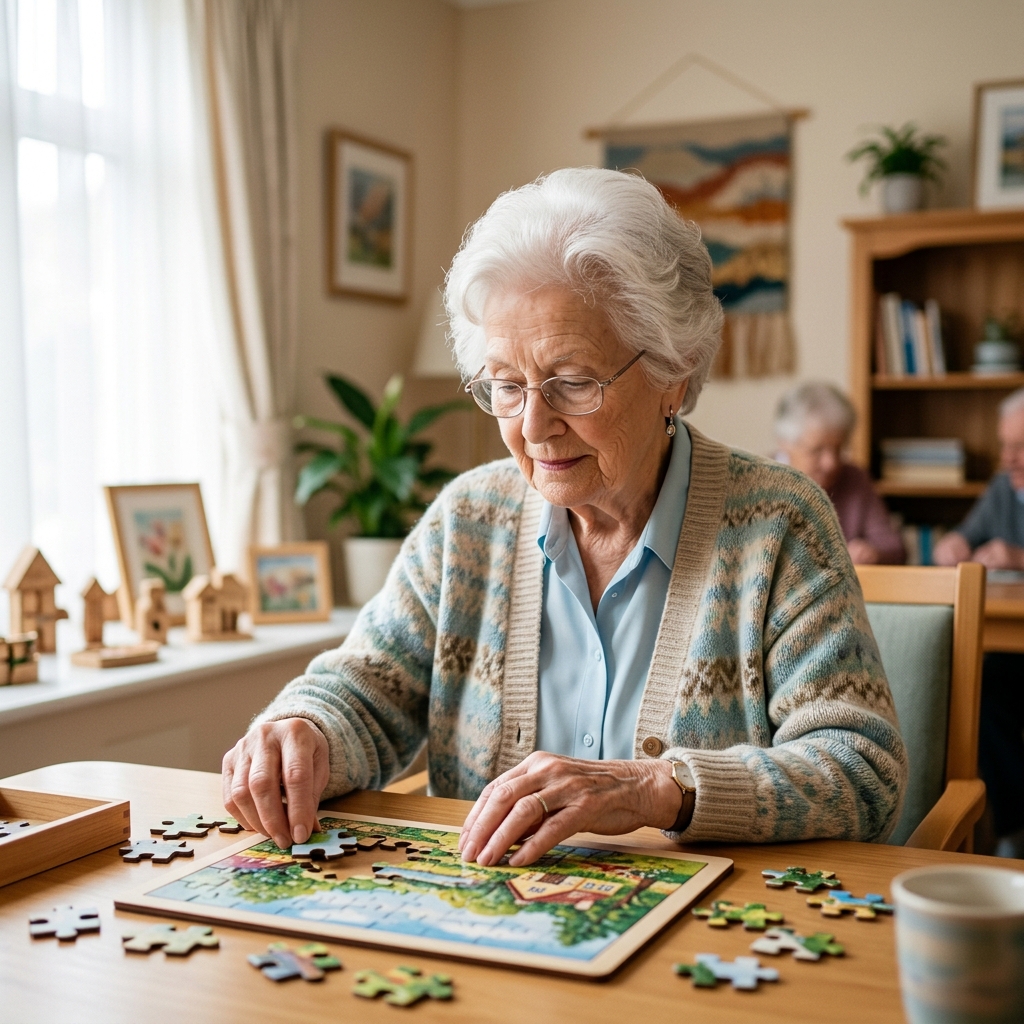
Most puzzle households have one: the box that has been “almost done” since spring, two-thirds sky, pushed to the far end of the dining table so people can eat. Choosing jigsaw puzzles for seniors, or for anyone with a free week and a flat surface, comes down to four things the box rarely spells out: how much table it eats, how the pieces feel in your fingers, how the surface behaves under a lamp, and whether the picture is a pleasure or a punishment.
- Sweet spot
- 500 pieces
- Table for 1,000
- About 2 by 3 feet
- Look for
- Linen or matte finish
Jigsaw puzzles for seniors: what the piece count means
The number on the box is a promise about time and territory. A 1,000-piece Ravensburger finishes at about 27 by 20 inches, and you need more table than that, because the loose pieces, the box lid and your coffee all want a spot too.
Time is harder to pin down. On MySpeedPuzzling, where enthusiasts log stopwatch times, the median solo finish for a 1,000-piece puzzle, across more than 16,000 recorded solves, is 3 hours 16 minutes. Those are people racing a clock. Puzzle publisher Galison suggests first-timers budget 8 to 15 hours for 1,000 pieces, spread over three or four sessions, which sounds more like a normal person whose phone rings.
| Pieces | Finished size (approx.) | Rough time | Table space |
|---|---|---|---|
| 100 | 8 x 10 in | 30 to 60 minutes | A tray or lap desk |
| 300 | 18 x 24 in | 1 to 5 hours | A card table |
| 500 | 18 x 24 in | 3 to 5 hours | A card table, about 24 x 36 in |
| 1,000 | 20 x 27 in | 8 to 15 hours for a first-timer | At least 24 x 36 in, left undisturbed |
| 2,000 | 30 x 39 in | 15 to 30+ hours | More than 30 x 40 in, ideally its own table |
Treat that as a rough guide, compiled from manufacturer listings and Galison’s estimates. Brands vary by a few inches, and your pace is nobody’s business.
If you are new to puzzles or coming back after decades away, 500 pieces is the sweet spot: big enough to feel like an accomplishment, small enough to finish before you start resenting it.
Large-piece puzzles for tired eyes and stiff hands
Piece count and piece size are two different things. A standard 1,000 and a large-format 500 can cover the same table. The second one just has bigger pieces.
Ravensburger’s Large Format 500s finish at 70 by 50 centimeters (about 27 by 20 inches), the same footprint as its 1,000s, with pieces roughly 36 millimeters across. The Royal National Institute of Blind People, which sells them in the UK, lists them as about 20 percent larger than standard. Cobble Hill makes an Easy Handling line of 275-piece puzzles with oversized, randomly shaped pieces and pictures pitched at grown-ups.
Springbok’s Puzzles to Remember line goes further: 36 or 100 pieces that finish at the size of the company’s 500-piece puzzles, made for people living with memory loss. It was inspired by Max Wallack, who as a 12-year-old started a nonprofit that collected puzzles for people with Alzheimer’s.
For stiff or arthritic fingers, thicker board is easier to pick up than thin, flimsy stock. A thin kitchen spatula or a bench scraper will slide a stubborn piece off a slick table, and a slightly tilted board means less hunching. If 1,000s have you squinting, drop to a large-format 500. Nobody is checking.
Piece quality: fit, cut and that satisfying click
A good puzzle tells you when you are right. The piece seats with a small, firm click, and you can lift a finished section a few inches without it collapsing. Springbok describes its pieces as “precision made” and interlocking, built to hold together when lifted.
A bad one gives you false fits, where a wrong piece slides in loosely and looks fine until three rows later. It also leaves puzzle dust, the papery fluff from the cutting process, all over your sweater.
The other quality question is the cut. A grid cut (also called a ribbon cut) puts pieces in neat rows with similar shapes, which makes sorting by shape easy and false fits more likely. A random cut gives every piece its own odd outline, so pieces are harder to sort by shape but usually fit in only one place. Ravensburger says every piece in its puzzles has “a completely unique shape,” and Cobble Hill calls its random-cut dies a signature.
Matte finish versus glare
A glossy puzzle under a ceiling light turns dark areas into a white sheen, and you end up tilting your head like a heron to see what color a piece is.
The fix is a linen finish, a fine crosshatch texture pressed into the printed paper that scatters light. Ravensburger prints on “linen structured paper” for what it calls a “glare-free” image, and Cobble Hill uses a linen texture on pieces and boxes. Glossy is not a dealbreaker on a bright image, though: one Jigsaw Junkies reviewer gave a glossy Buffalo Games puzzle 9 out of 10 while noting it can glare under overhead lights. If you already own a shiny one, move the lamp off to the side.
Why some images are brutal
The picture decides your fate more than the piece count does. The hard ones share a pattern: large stretches of a single color (sky, sea, snow, fog), soft gradients, repeating patterns like jelly beans or tartan, and Impressionist paintings where everything is a dab of the same blue-green.
A 1,000-piece picture of a cloudless sky is less a hobby than a sentence.
The friendly ones have lots of distinct regions: collages of separate objects, buildings with signs and windows, bold blocks of color, readable text. White Mountain built much of its catalog on nostalgic collages like “Candy Wrappers” and “Games We Played,” where every piece belongs to something you can name.
Pick an image you would happily stare at for ten hours. You are going to.
Puzzle brands worth knowing
- Ravensburger. German maker. Linen-structured, glare-free surface, uniquely shaped pieces and a firm fit sold as “Softclick.” Large Format versions in 300, 500 and 750 pieces.
- Cobble Hill. Founded in 2005 and based in Victoria, British Columbia. Random cuts, linen texture, boxes color-coded by piece count, and the Easy Handling large-piece line.
- Buffalo Games. Making puzzles in Buffalo, New York, since 1986, about 10 million a year by its own count. Easy to find in ordinary stores, with a deep catalog including Charles Wysocki’s folksy Americana.
- White Mountain. A family company from Jackson, New Hampshire, with puzzles made in the USA from blue chipboard. Known for nostalgia collages that start conversations at the table.
- Springbok. Founded in 1963 and owned by Hallmark from 1967 to 2001, when the puzzles were sold only in Hallmark stores. Known for individually shaped pieces, round puzzles and the Puzzles to Remember line.
- Eurographics. The pick for fine art (Van Gogh, Monet, Kandinsky) and reference-chart images like flags of the world or instruments of the orchestra. Its “Smart Cut” pieces come in varied shapes, printed with vegetable-based ink on recycled board.
Sorting and lighting tips
- Flip everything face up first. Tedious, but it saves turning the same piece over nine times.
- Pull the edges. The frame is an early win.
- Sort by color, then by shape. Baking sheets, pie tins and shallow box lids make good trays and stack out of the way.
- Start with the most distinctive part. A red barn, a sign, a face. Save the sky for last, when there are fewer pieces left to try.
- Prop up the box. Keep the picture upright at eye level instead of flat on the table.
Then fix the light. The Lighting Research Center at Rensselaer Polytechnic Institute, in guidance prepared with AARP, says homes used by older adults need at least 50 percent more light overall, and task areas need at least three times more light to see fine detail. A puzzle is nothing but fine detail.
Puzzle mats, boards and the cat
If the dining table has to work for dinner too, you need a way to move a half-done puzzle.
- Roll-up mats. A felt mat you roll around a tube. Cheap and compact, though loose sections can shift if you roll carelessly.
- Rigid boards. Flat boards with a cover or sorting drawers that slide under a sofa or bed. Sturdier and better for 1,000s, and harder for the cat to rearrange.
- Tilting tabletop easels. They raise the puzzle at an angle, so you look across it instead of down at it. Your neck will notice.
- Foam board. A sheet from a craft store, a bit bigger than your puzzle, is the bargain version of a board.
Are jigsaw puzzles good for your brain?
The honest answer is “probably a little, over the long haul, and the evidence is thinner than the box copy suggests.”
The best puzzle-specific research is a 2018 study in Frontiers in Aging Neuroscience led by Patrick Fissler. In 100 adults 50 and older, jigsaw puzzling drew on multiple thinking skills, and people with more lifetime puzzle experience scored better on visuospatial tests (judging shapes and how parts fit together). But the trial half of the study found that 30 days of puzzling, at least an hour a day, did not improve visuospatial thinking any more than the control group’s brain-health counseling. The authors suggest long-term puzzling may help, while a five-week burst does not.
A larger study from Rush University, published in Neurology in 2021, followed 1,903 people with an average age of 80 for about seven years. Those who reported the most cognitively active lives, including puzzles, card games, reading and letter writing, developed Alzheimer’s dementia at an average age of 94, versus 89 for the least active. That is an association, not proof, and the group was mostly white and highly educated.
A 2017 National Academies committee reviewed the bigger picture and called the evidence for cognitive training “encouraging although inconclusive.” If you are noticing real memory changes, that is a conversation for your doctor, and no box of 1,000 pieces replaces it.
Questions readers ask
How long does a 1,000-piece puzzle take?
Longer than you think. Experienced puzzlers who time themselves on MySpeedPuzzling have a median of about 3 hours 16 minutes, but they are racing. Galison suggests first-timers plan on 8 to 15 hours over three or four sessions. Image matters: a busy collage goes faster than a sky or a seascape.
What piece count is best for older adults?
For most people, 500 pieces is the sweet spot: satisfying, but finishable in a few sittings on a card table. If small pieces strain your eyes or hands, try a large-format 500 or a 275-piece large-piece puzzle, which covers a similar area with bigger, easier-to-grip pieces.
Are jigsaw puzzles good for your brain?
Possibly, over the long term. A 2018 study found lifetime puzzlers scored better on visuospatial tests, but five weeks of daily puzzling did not beat a control group. A 2021 Rush study linked cognitively active lives, including puzzles, to later dementia onset. Neither study proves puzzles prevent dementia.
How do I stop glare on a jigsaw puzzle?
Buy puzzles with a linen or matte finish, which Ravensburger and Cobble Hill both use, since the texture scatters light. Then move your lamp. A bright light placed low and off to one side gives you plenty of light without reflecting straight back off the pieces into your eyes.
Sources we checked (20) Rules and prices change, so confirm details before you act.
- Frontiers in Aging Neuroscience (via PMC): Jigsaw Puzzling Taps Multiple Cognitive Abilities and Is a Potential Protective Factor for Cognitive Aging
- American Academy of Neurology: Keeping Your Brain Active May Delay Alzheimer’s Dementia 5 Years
- Rush University Medical Center: Remaining Mentally Active May Delay Dementia Onset
- NIH: National Academies Committee Sees Promising but Inconclusive Evidence for Interventions to Prevent Cognitive Decline and Dementia
- Lighting Research Center, Rensselaer Polytechnic Institute: Lighting Principles for Older Adults
- MySpeedPuzzling: How Long Does a 1000 Piece Puzzle Take?
- Galison: What Size Jigsaw Puzzle Should I Buy? 100 vs 500 vs 1000 Pieces Explained
- Ravensburger Australia: Gardener’s Paradise 2000 Pieces
- Cogs Toys and Games: The Reading Room Ravensburger Puzzle 1000 Piece
- Ravensburger: Care Commitment
- RNIB Shop: Large Format 500pc Rose Cottage Ravensburger Jigsaw Puzzle
- Cobble Hill: Our History
- Jigsaw Junkies: Cobble Hill Easy Handling
- Springbok Puzzles: Springbok Puzzles History
- Cure Alzheimer’s Fund: Springbok Puzzles Partners with Cure Alzheimer’s Fund
- White Mountain Puzzles: Home page
- Jigsaw Junkies: Puzzle Maker Interview, White Mountain Puzzles
- WGRZ: Buffalo Games produces millions of puzzles in Buffalo
- Jigsaw Junkies: Review, Waterfall Valley by Charles Wysocki, Buffalo Games
- PDK: Eurographics Jigsaw Puzzles
Leave a Reply