Balance exercises you can do while the kettle boils
Eight moves built on CDC and NHS guidance, each fitted into a few minutes you already spend waiting, with easier and harder versions for every one.
In this story
Set up the kitchen
1. Heel-to-toe stand
2. One-leg stand
3. Heel raises
4. Toe raises
5. Side leg raise
6. Sideways walk
7. Heel-to-toe walk
8. Chair rise
Safety and your doctor
Track your progress
Beyond the kitchen
Questions readers ask
An electric kettle takes a few minutes to boil, and most of us spend them staring at it, which has never once made it go faster. Those minutes are enough for a set of balance exercises for seniors that need no gym, no mat and no special outfit. You already own the equipment: a kitchen counter, a sturdy chair and two feet.
The reason to bother is plain. According to the CDC, more than one in four adults 65 and older falls each year, and fewer than half of them tell their doctor. Falling once doubles your chances of falling again. In 2024, older adult falls led to about 4.5 million emergency room visits and more than 43,000 deaths, making falls the leading cause of injury death for people 65 and up.
The CDC is equally plain about the remedy: exercises that improve balance and make your legs stronger lower your chances of falling. We built the routine below from CDC, NHS and National Library of Medicine guidance, then hung each move on a moment you already have: the kettle, the toothbrush, the microwave.
- Time
- 2 to 5 minutes at a stretch
- Equipment
- A solid counter and a sturdy chair
- How often
- Most days; at least twice a week
Balance exercises for seniors: set up the kitchen first
Pick the stretch of counter nearest the kettle and clear the floor in front of it. Loose rugs, dropped dish towels and the cat all count as hazards.
- Hold something that cannot move. The Otago programme, a falls-prevention routine used by NHS physiotherapists, says never to steady yourself on anything that could shift, such as a chair. A counter or a solid table is ideal.
- Wear real shoes. The NHS recommends shoes or slippers that fit well, stay on and have a good grip. Socks on tile are a balance exercise nobody signed up for.
- Use the three support levels. Otago progresses from two hands on the counter, to one hand, to no hands. Every exercise below follows that ladder. Climb it slowly.
One house rule: exercise while the water heats, then stand on both feet to pour it.
Nobody needs a balance challenge that involves boiling water.
1.Heel-to-toe stand (while the kettle boils)
This is stage three of the CDC’s 4-Stage Balance Test, the one doctors use to screen for fall risk.
- Face the counter with both hands resting on it.
- Place one foot directly in front of the other, heel touching toe, as if you were on a tightrope.
- Look straight ahead and hold for 10 seconds.
- Switch feet and hold another 10 seconds. Repeat until the kettle clicks off.
Easier: Use the CDC’s in-between position: the instep of one foot touching the big toe of the other.
Harder: One hand on the counter, then fingertips, then hands hovering just above it.
2.One-leg stand (while you brush your teeth)
The American Dental Association asks for two minutes of brushing, twice a day. That is a lot of standing around.
- Rest your free hand on the edge of the sink.
- Lift one foot just off the floor. Keep your hips level and a slight bend in the standing knee, as the NHS instructs.
- Hold for 5 to 10 seconds, lower gently, then switch legs.
- Aim for three lifts on each side, which the NHS balance guide recommends.
Easier: Finish brushing first, then do it with both hands on the sink.
Harder: Fingertips only, working toward the full 10 seconds per leg.
3.Heel raises (while the microwave counts down)
The microwave display is a ready-made timer, and 90 seconds of reheated coffee is plenty.
- Hold the counter and stand tall, knees slightly bent.
- Rise onto your tiptoes as high as you comfortably can.
- Lower your heels slowly. The lowering is where the work happens.
- Do 10 to 15, the range MedlinePlus suggests.
Easier: Two hands on the counter and a smaller rise.
Harder: One hand, a slower count down, and work up to the 20 repetitions in the Otago programme.
4.Toe raises (while the toast browns)
Heel raises have a less famous sibling. This one works the muscles along the front of your shin, the ones that lift your toes as you walk.
- Hold the counter with both feet flat, hip-width apart.
- Rock back onto your heels and lift the front of both feet off the floor.
- Lower slowly and repeat. Otago builds toward 20.
Easier: Fewer repetitions, with both hands firmly on the counter and a smaller lift.
Harder: Hold on with one hand, or alternate with a heel raise to make a slow, controlled rock.
5.Side leg raise (while the coffee drips)
Your hip muscles do the steering when you move sideways, which you do every time you sidestep a grandchild or a dog.
- Stand side-on to the counter, holding it with the near hand.
- Keep the outside leg straight and its toes pointing forward.
- Lift the leg out to the side without leaning the other way, then lower it.
- Do 10, turn around and do the other leg. A North Tees and Hartlepool NHS leaflet suggests two sets of 10.
Easier: Step out to the side and back instead of lifting.
Harder: Add a lift forward and a lift back, or loop a light resistance band around your thighs, both progressions from the same NHS leaflet.
6.Sideways walk (while the pasta water heats)
A pot of pasta water takes long enough to boil that you could learn the grapevine. You will.
- Stand with your feet together, knees slightly bent, one hand on the counter.
- Step sideways slowly with one foot, then bring the other to meet it.
- Keep your hips from dropping as you step.
- Take 10 steps one way, then 10 steps back.
Easier: Both hands sliding along the counter, and shorter steps.
Harder: The NHS “simple grapevine”: cross one foot over the other, bring the second foot alongside, and repeat for 5 cross-steps each way. The NHS notes that smaller steps work your balance harder.
7.Heel-to-toe walk (along the counter)
The CDC’s physical activity guidelines name walking heel-to-toe as a balance activity for older adults.
- Stand beside the counter with one hand on it.
- Place your right heel directly in front of your left toes.
- Then place your left heel directly in front of your right toes.
- Keep your eyes forward, not on your feet. Start with 5 steps.
Easier: Fewer steps, with a slightly wider foot placement.
Harder: Lighter hand contact, and work up to the 20 steps in the Otago programme, turning at the end to come back.
8.Chair rise (during the commercial break)
This one comes straight from a CDC brochure in its STEADI fall-prevention program (Stopping Elderly Accidents, Deaths and Injuries). Push the chair against a wall so it can’t slide.
- Sit toward the front of a sturdy chair, knees bent, feet flat and shoulder-width apart.
- Rest your hands lightly on the seat. Keep your back and neck straight, chest slightly forward.
- Breathe out as you slowly stand, using your hands as little as possible.
- Breathe in as you lower yourself. Control the descent rather than dropping into the seat.
- Do 10 to 15, rest a minute, then do another set.
Easier: Start with fewer, or use a chair with arms and push off them.
Harder: No hands at all, arms crossed over your chest.
When to stop, and when to call the doctor
These moves should feel like work, never like a gamble. MedlinePlus says to stop if you have pain, dizziness or trouble breathing during or after exercise, and to check with your provider before continuing. Chest pain, or being too short of breath to talk, means stop and call your doctor. And don’t hold your breath.
Doctors who follow the CDC’s STEADI program screen with three questions: have you fallen in the past year, do you feel unsteady when standing or walking, and do you worry about falling. A yes to any one leads to a closer look, such as the Timed Up and Go test or the 30-second chair stand. If your walking, strength or balance comes up short, STEADI tells your doctor to refer you for physical therapy. A physical therapist can tailor a program to you, which a magazine article cannot.
You can do a rough self-check first. The CDC’s 12-question Stay Independent checklist takes two minutes, about one kettle. A score of 4 or more means you may be at risk and should talk to your doctor. While you are there, the CDC also suggests asking your doctor or pharmacist whether any of your medicines cause dizziness or drowsiness, and getting your eyes checked at least once a year.
How to tell if it’s working
Keep a notebook and pen by the kettle. Once a week, write down three numbers:
- Heel-to-toe stand: seconds held, each foot in front. The CDC says an older adult who cannot hold this position for at least 10 seconds is at increased risk of falling, which makes 10 seconds your first target.
- One-leg stand: seconds held on each side, and how many hands you needed.
- 30-second chair stand: arms crossed on your chest, count how many times you come to a full stand in 30 seconds. If you need your arms, the score is zero. Have someone nearby; the CDC tells clinicians to stand next to the person being tested.
The CDC’s 30-Second Chair Stand sheet lists these scores as below average, a sign of fall risk:
| Age | Men below | Women below |
|---|---|---|
| 65 to 69 | 12 | 11 |
| 70 to 74 | 12 | 10 |
| 75 to 79 | 11 | 10 |
| 80 to 84 | 10 | 9 |
| 85 to 89 | 8 | 8 |
The other measure of progress is your grip on the counter. Two hands becoming one hand, and one hand becoming fingertips, is the whole point of the Otago ladder.
Beyond the kitchen
The NHS recommends activities that improve strength and balance at least twice a week, and the kettle routine gets you there without trying. If you want company, the CDC names tai chi as a good example of balance exercise, and its Stay Independent brochure suggests calling your local community or senior center about fall prevention and exercise programs.
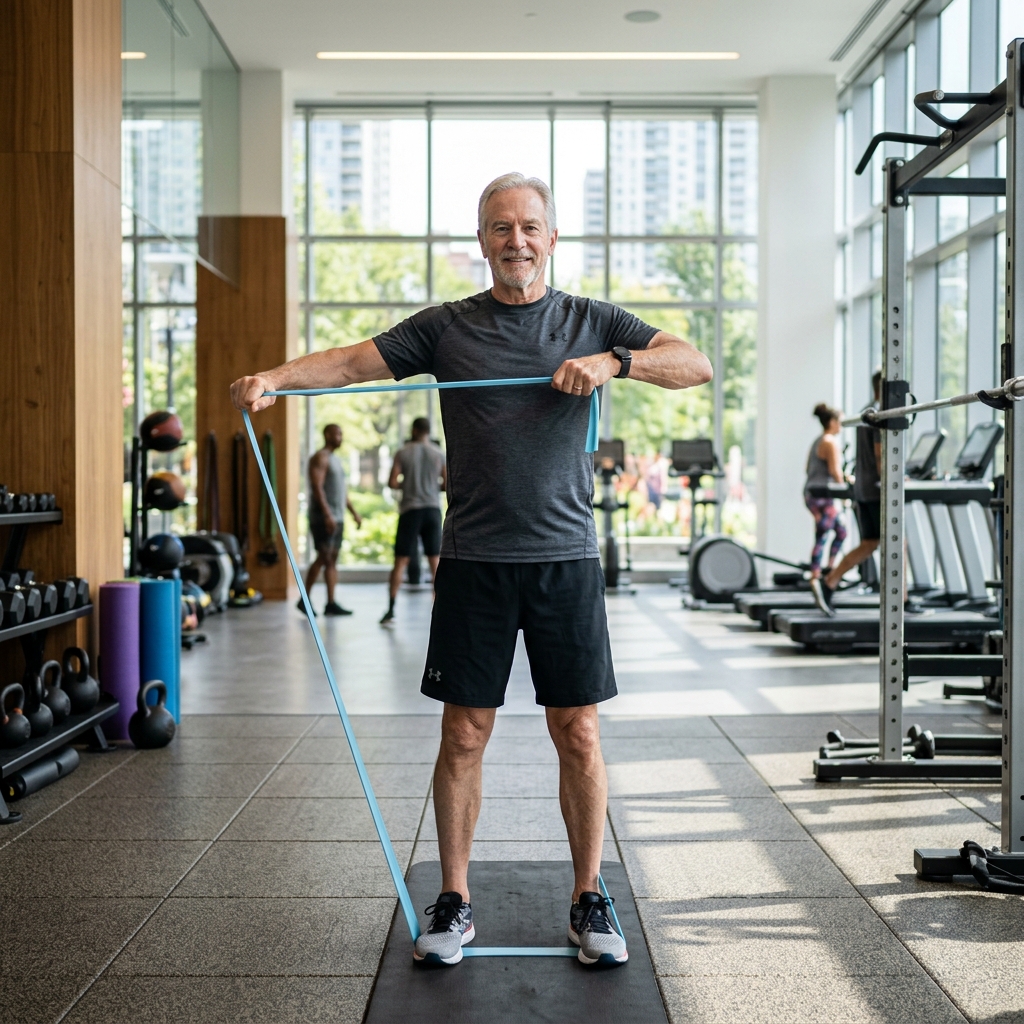
Many of those classes use resistance bands, chairs and a wall. You have two of the three already.
Questions readers ask
What is the best balance exercise for seniors?
There is no single best one, but the heel-to-toe stand is a strong place to start. The CDC uses it in its 4-Stage Balance Test, and an older adult who cannot hold it for 10 seconds is at increased risk of falling. Hold a counter, place one heel against the other foot’s toes, and build toward 10 seconds.
How often should older adults do balance exercises?
The NHS recommends activities that improve strength and balance at least twice a week, and the Otago programme, as used by NHS physiotherapists, prescribes its exercises three times a week. Short daily sessions tied to routines like boiling the kettle or brushing your teeth make it easy to hit those targets without setting aside a workout slot.
Can you still improve your balance in your 70s or 80s?
Yes. The CDC says there are proven ways to reduce and prevent falls, even for older adults, and that exercises improving balance and leg strength lower your chances of falling. Start with plenty of support from a counter, progress slowly, and ask your doctor about a physical therapist if you feel unsteady.
How long should an older adult be able to stand on one leg?
In the CDC’s 4-Stage Balance Test, each position, including standing on one foot, is held for 10 seconds. The key warning sign is the stage before it: struggling to hold a heel-to-toe stand for 10 seconds signals increased fall risk. If either feels impossible, mention it to your doctor and ask for a falls risk check.
Sources we checked (17) Rules and prices change, so confirm details before you act.
- CDC: Facts About Older Adult Falls
- CDC: About Older Adult Fall Prevention
- CDC: Older Adult Falls Data
- CDC: Preventing Falls and Hip Fractures
- CDC STEADI: The 4-Stage Balance Test
- CDC STEADI: 30-Second Chair Stand
- CDC STEADI: Chair Rise Exercise
- CDC STEADI: Stay Independent brochure and checklist
- CDC STEADI: What You Can Do to Prevent Falls
- CDC STEADI: Pocket Guide, Preventing Falls in Older Patients
- CDC: Physical Activity Guidelines for Older Adults
- NHS: Balance exercises
- NHS: Falls
- Royal Orthopaedic Hospital NHS Foundation Trust: Otago strength and balance exercises
- North Tees and Hartlepool NHS Foundation Trust: Balance exercises
- MedlinePlus (National Library of Medicine): Exercises to help prevent falls
- American Dental Association: Home oral care
Leave a Reply